
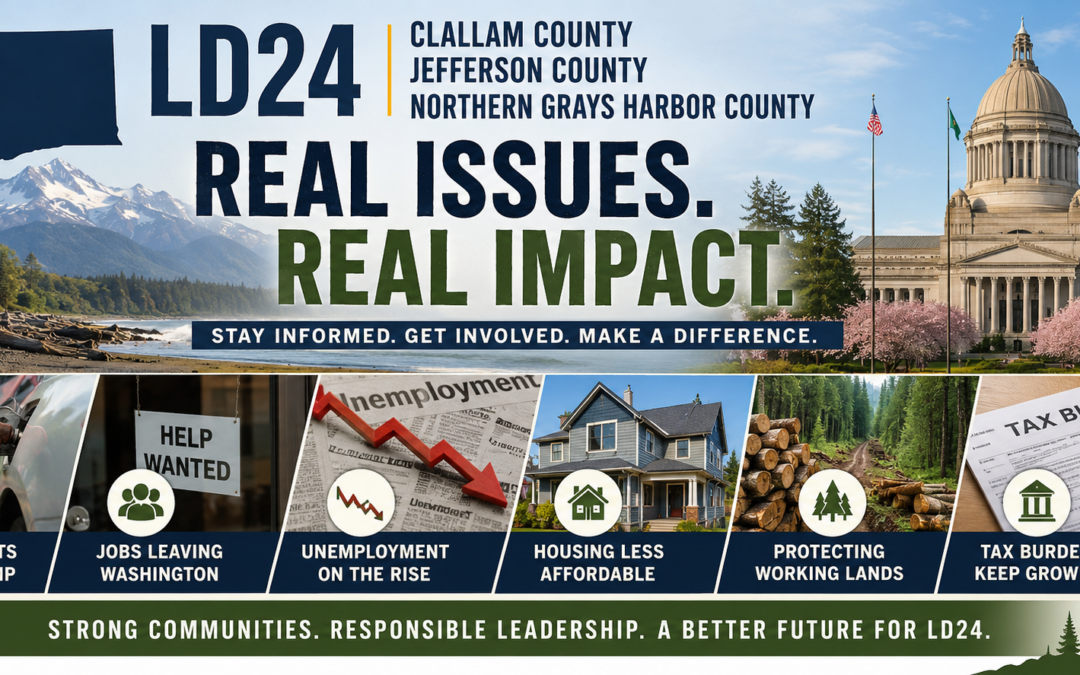
The 2026 legislative session may be over, but the effects of the decisions made in Olympia are only beginning to be felt across our district.
For residents of Clallam, Jefferson, and northern Grays Harbor counties, the concerns are often different from those of Seattle, Bellevue, or Tacoma. Rural communities depend on affordable energy, family-wage jobs, working forests, local agriculture, small businesses, and housing that ordinary families can afford.
Unfortunately, many of the policies coming out of Olympia continue to move Washington in the opposite direction.
Rising Costs Continue to Hit Working Families
One of the most visible impacts is at the gas pump.
Washington continues to have some of the highest gasoline prices in the nation, largely due to policies enacted in recent years. The state’s Climate Commitment Act has added significant costs throughout the fuel supply chain. While supporters argue the program funds environmental initiatives, many families are asking a simple question:
How much more can working people afford?
For a family in Forks, Quilcene, Port Angeles, Sequim, Aberdeen, or Hoquiam, driving is not optional. Parents commute to work. Contractors travel between job sites. Seniors drive long distances for medical appointments. Every increase in fuel prices ripples through the economy, increasing the cost of groceries, goods, and services.
The burden falls hardest on rural communities because there are fewer alternatives.
Businesses Are Voting With Their Feet
Another troubling trend is the growing number of employers reconsidering their future in Washington.
Recent reports have shown that a significant number of Washington businesses are exploring relocation due to rising taxes, regulations, and operating costs. The announcement by Janicki Industries that it will invest hundreds of millions of dollars in Montana rather than Washington sent shockwaves through many communities.
When businesses expand elsewhere, Washington loses more than jobs.
We lose future tax revenue, apprenticeship opportunities, charitable giving, and economic stability. Rural counties already struggle to attract major employers. Every company that leaves makes it harder for the next generation to find family-wage careers without moving away.
Former Governor Christine Gregoire recently warned that Washington’s economic advantages can no longer be taken for granted. Even business leaders who have traditionally supported state leadership are beginning to sound alarms about competitiveness.
The question policymakers should be asking is simple:
Why are so many employers choosing other states?
Unemployment Is Climbing
At the same time businesses are expressing concern, unemployment numbers have been trending upward.
For rural communities, unemployment statistics are not just numbers on a spreadsheet. They represent neighbors, friends, and family members facing uncertainty.
When job losses occur in rural areas, the impacts often last longer because there are fewer employers available to absorb displaced workers. Local restaurants, retail stores, service providers, and community organizations all feel the effects when fewer people have disposable income.
Economic warning signs should be taken seriously before they become full-scale economic problems.
The Housing Dream Is Moving Further Out of Reach
Homeownership has long been one of the foundations of the American Dream.
Yet recent data shows Washington ranking near the bottom nationally for homeowners who have paid off their mortgages. Housing costs continue to rise, while interest rates, taxes, insurance, and utility costs add even more pressure.
In many parts of the state, families now need incomes that would have been considered extraordinary just a decade ago to purchase an average home.
Young families are delaying homeownership. Retirees are struggling with property taxes. Adult children are remaining with parents longer because housing costs are unaffordable.
Many Washington residents are beginning to ask whether state policies are helping solve the housing crisis or making it worse.
Working Forests Face Growing Pressure
Perhaps no issue affects rural Washington more directly than land use decisions.
The Department of Natural Resources is currently studying proposals that could remove additional trust lands from productive use in portions of the Olympic Peninsula. While environmental stewardship is important, every acre removed from production has consequences.
Trust lands generate revenue for schools, fire districts, hospitals, and local governments. Timber harvests support family-wage jobs while funding critical public services.
When productive lands are locked away, local governments often have only one way to make up lost revenue: higher taxes on remaining taxpayers.
This creates a difficult question for rural communities:
How much land can be removed from productive use before taxpayers and local services begin paying the price?
Many residents believe there must be a balance between conservation and maintaining the economic foundations that support local communities.
Tax Burdens Continue to Grow
Property taxes, fees, utility costs, fuel costs, and new business taxes continue placing pressure on household budgets.
Many residents feel that state government is increasingly asking taxpayers to fund larger budgets while delivering fewer measurable improvements in affordability, public safety, or economic opportunity.
The concern is especially acute in rural counties where incomes tend to be lower than urban areas, yet residents still face many of the same rising costs.
Families cannot continue absorbing endless increases without consequences.
Eventually people change spending habits, delay investments, relocate, or leave the state altogether.
Rural Voices Matter
One theme connects nearly every issue facing Legislative District 24.
Too often, decisions are made in Olympia without fully considering how they affect rural communities.
The needs of Forks are not the same as Seattle.
The economy of Jefferson County is not the same as King County.
The challenges facing Grays Harbor differ dramatically from those in Bellevue.
Yet state policies frequently apply one-size-fits-all solutions to communities with very different realities.
Rural Washington provides timber, agriculture, fisheries, manufacturing, tourism, and natural resources that help power the entire state economy. These communities deserve a seat at the table and policies that recognize their unique contributions.
As residents of LD24 look ahead, the challenge will be ensuring that their voices are heard and that policymakers understand a simple truth:
Strong rural communities are not a burden on Washington.
They are one of its greatest strengths.
Moving Forward
The coming months will reveal whether state leaders are willing to address the affordability crisis, protect family-wage jobs, preserve working lands, and create an environment where businesses and families can thrive.
The future of Washington will not be determined solely in Seattle or Olympia.
It will also be determined in the small towns, rural communities, and working landscapes of Clallam, Jefferson, and Grays Harbor counties.
The question is whether state leaders are listening.
Sources:
- Washington State Standard
- Seattle Times housing affordability analysis
- Association of Washington Business Spring 2026 Survey
- Washington Policy Center
- Washington State Employment Security Department
- Department of Natural Resources (DNR)
- Economic and Revenue Forecast Council (ERFC)
- Washington State Department of Ecology Climate Commitment Act reports
- Chronline unemployment reporting
- Janicki Industries expansion announcement
- Puget Sound Regional Council economic outlook presentations