
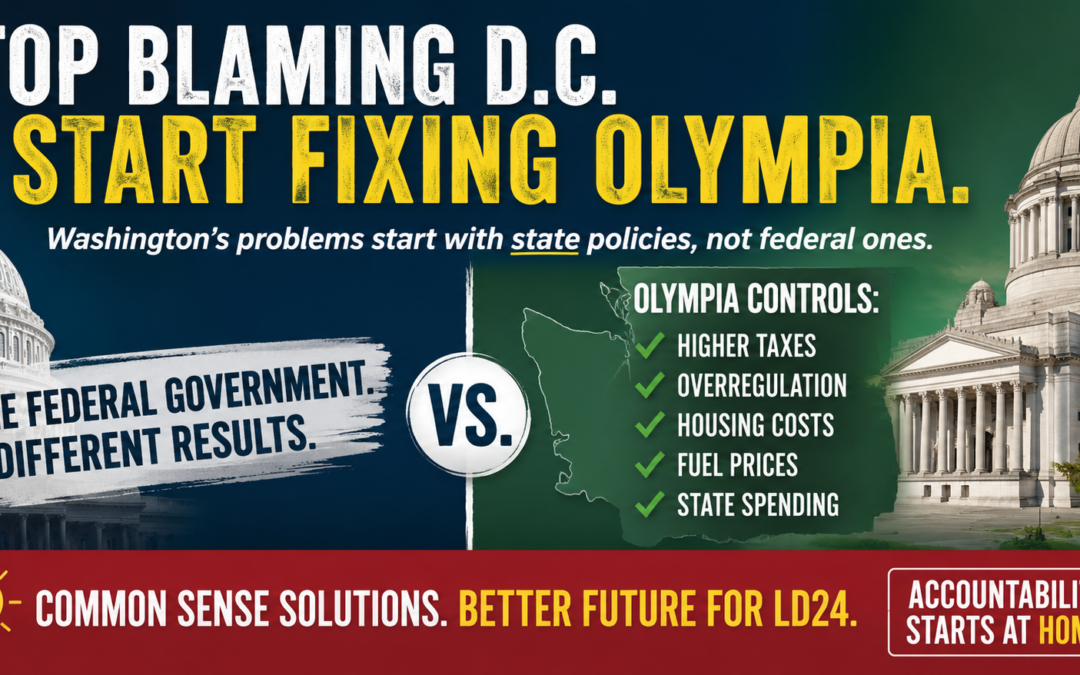
If federal policies are the main reason Washington is struggling, why are neighboring states operating under the exact same federal government experiencing different outcomes?
Every state deals with the same President, Congress, Federal Reserve, federal regulations, tariffs, immigration policies, and national economic conditions. Yet states have dramatically different costs of living, housing affordability, business climates, tax burdens, unemployment rates, and population trends.
At some point, we have to look at what Washington is doing differently.
Areas the State Controls
Housing Costs
Washington lawmakers do not control federal interest rates, but they do control:
- State environmental regulations
- Permitting requirements
- Growth management policies
- Impact fees
- Building regulations
- Property taxes and local levies
When it takes years to permit housing and developers face increasing costs before a shovel even hits the ground, those costs get passed directly to homebuyers and renters.
Federal interest rates affect everyone. State policies determine how expensive housing becomes on top of those rates.
Gas Prices
Federal oil policies affect fuel prices nationally.
But Washington consistently ranks among the highest gas prices in America because of state-specific policies such as:
- The Climate Commitment Act
- Low Carbon Fuel Standard requirements
- State fuel taxes
Drivers in Idaho, Montana, and many other states buy fuel influenced by the same global oil market and federal policies, yet often pay significantly less because they don’t carry the same state-imposed costs.
Business Climate
The federal government doesn’t set Washington’s:
- B&O tax rates
- Capital gains tax
- State labor regulations
- State environmental compliance costs
- State permitting delays
When businesses announce expansions in Idaho, Montana, Texas, Tennessee, or Utah instead of Washington, they’re often comparing state policies, not federal policies.
State Budget Growth
Washington’s state budget has grown dramatically over the past decade.
Federal policies don’t determine:
- How much Olympia spends
- Which programs are funded
- How many taxes are increased
- How much state government expands
Those are decisions made by state lawmakers.
The Accountability Test
A simple way to evaluate any claim is this:
If Washington gets credit when things go well, shouldn’t Washington also accept responsibility when things go poorly?
When:
- Tax revenues are breaking records
- New programs are created
- Budgets increase
State leaders often point to their policies as successes.
But when:
- Housing becomes unaffordable
- Businesses leave
- Gas prices rise
- Families struggle
The explanation suddenly becomes federal policy, corporate greed, or factors outside state control.
Common sense suggests the truth is probably somewhere in the middle. Federal policies matter. Global markets matter. But state policies matter too.
A Simple Analogy
If every family on the block pays the same electric rate, shops at the same grocery store, and deals with the same inflation, but one family is still struggling more than the others, eventually you have to examine that household’s budget decisions.
The same principle applies to states.
Washington cannot control everything happening nationally. But it can control many of the policies that affect affordability, economic growth, housing costs, energy prices, and business investment.
When those indicators continue moving in the wrong direction, voters should ask a reasonable question:
At what point do we stop blaming Washington, D.C., and start examining the decisions being made in Olympia?
#WashingtonState #Olympia #CostOfLiving #HousingAffordability #GasPrices #TaxpayerAccountability #CommonSense #LD24 #WashingtonPolitics #GovernmentAccountability