
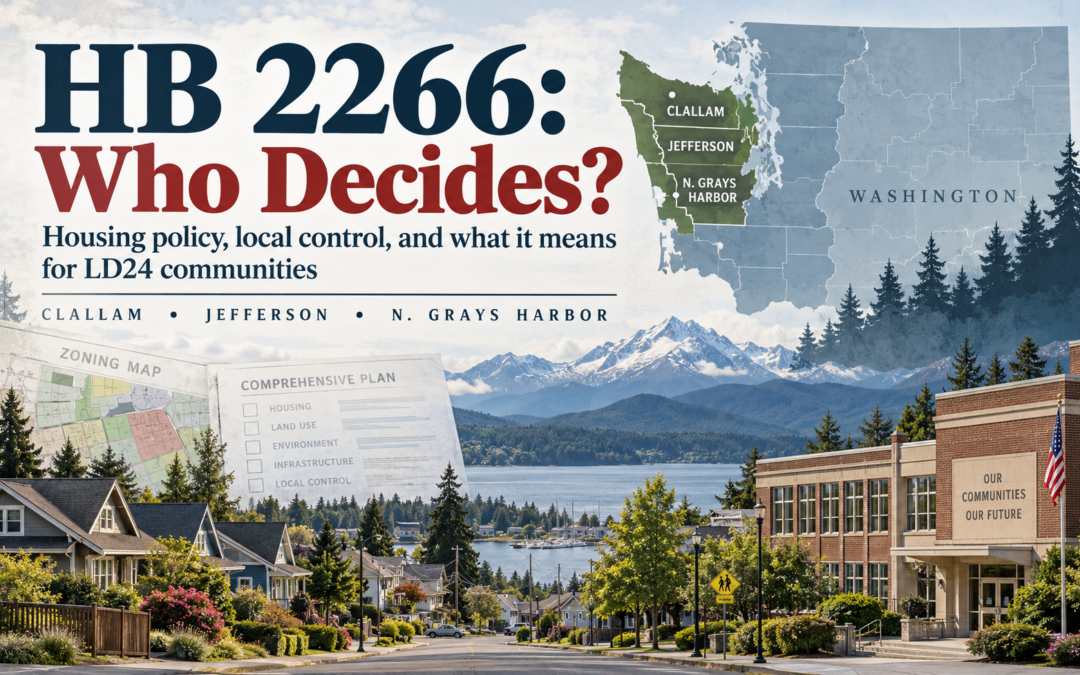
Washington has passed a new housing law that changes what local governments can regulate. Here is what residents of Legislative District 24 need to know, and why the upcoming election and public comment period matter.
Helping People While Protecting Our Communities
Most of us can agree on something: people need a safe place to live, and communities should be able to make reasonable decisions about what happens in their own neighborhoods.
But what happens when the state government decides where certain types of housing must be allowed, even when local officials or residents have concerns?
That is one of the questions surrounding Washington’s House Bill 2266, which became law on June 11, 2026.
The law changes how cities and counties regulate homeless shelters, transitional housing, emergency housing, and permanent supportive housing. It also limits some of the decisions local governments can make.
For residents of Clallam County, Jefferson County, and northern Grays Harbor County, understanding these changes matters because local planning decisions affect neighborhoods, schools, emergency services, infrastructure, and taxpayers.
What Exactly Is HB 2266?
Washington uses the term STEP housing, which covers four types of housing:
- Emergency shelters: Temporary places for people experiencing homelessness.
- Emergency housing: Temporary housing that provides shelter and basic necessities.
- Transitional housing: Housing that helps people work toward stable, permanent living arrangements.
- Permanent supportive housing: Long-term housing combined with supportive services for individuals who need ongoing assistance.
These are different types of facilities, serving different needs.
Supporters of HB 2266 believe reducing zoning restrictions will help communities build needed housing more quickly.
But the law raises another important question: How much authority should local communities have over where these facilities are located and how they operate?
What Does the New Law Actually Do?
Before HB 2266, Washington already required many cities to make room for STEP housing under legislation passed in 2021.
HB 2266 expands those requirements to counties that fully plan under the Growth Management Act and strengthens the state’s authority over local zoning decisions.
In simple terms:
If certain residential housing or hotels are allowed in a qualifying area, local governments generally must also allow the corresponding types of STEP housing.
For example, transitional and permanent supportive housing must generally be permitted in urban growth area zones allowing homes or hotels. Indoor emergency shelters and emergency housing must generally be permitted where hotels are allowed, with additional zones required if necessary to accommodate projected needs.
Perhaps the most significant provision is called preemption.
That means state law overrides local rules that conflict with it.
Local governments can still enforce ordinary building codes, fire regulations, setbacks, stormwater requirements, and other applicable safety standards. However, they generally cannot impose tougher requirements on STEP housing than on comparable residential or lodging developments, except where state law specifically permits additional conditions.
And these restrictions are already in effect, even though local governments have until June 11, 2028, or their next required comprehensive-plan update, whichever comes first, to formally update their regulations.
What About Schools and Neighborhood Safety?
One provision allows additional safety discussions when certain emergency shelters or emergency housing facilities are proposed within 500 feet of walking distance of a school or another qualifying emergency facility.
Local governments may negotiate reasonable additional safety protocols. Under specified circumstances, they may deny a permit if an agreement cannot be reached within 180 days.
However, this is not an automatic 500-foot ban.
There are exceptions, including facilities serving families, minors, or domestic violence victims.
Local governments may also require emergency facility operators to certify that they have notified nearby residents, held community meetings, identified an emergency contact, and documented operational policies.
These provisions provide some safeguards, but they also raise questions about ongoing oversight and accountability after a facility opens.
What Does This Mean for Legislative District 24?
Our communities are not all affected in exactly the same way.
Clallam County: Areas including unincorporated Sequim and Clallam Bay/Sekiu are already part of discussions about housing capacity and future zoning. Port Angeles and Sequim must also address applicable state requirements through their own city regulations.
Jefferson County: The Irondale and Port Hadlock urban growth area is undergoing planning changes involving future housing needs. Port Townsend also has responsibilities under statewide housing requirements.
Northern Grays Harbor County: Grays Harbor is a partially planning county under the Growth Management Act, so the same provisions do not apply to its unincorporated areas in precisely the same way. Separate state requirements and local planning rules still matter, including those affecting STEP facilities.
An important distinction: HB 2266 does not automatically order a shelter to be built in any particular neighborhood. It changes where qualifying facilities must be permitted and how local governments may regulate them.
Who Pays for the Additional Costs?
This question deserves more public discussion.
HB 2266 does not automatically require counties to build or operate shelters. Many facilities are developed and operated by nonprofits, private organizations, or government partnerships.
But communities may face costs associated with emergency responses, transportation, utilities, inspections, and other public services.
Actual costs depend on the specific project. The law does not provide a blanket promise that Washington will reimburse local governments for every additional expense.
Residents should be asking whether local service providers have sufficient resources, who is responsible for facility operations, and how any financial impacts will be measured.
Can the November Election Change This Law?
Yes, but not automatically.
Washington voters will elect state representatives on November 3, 2026. Those legislators will help determine which laws are considered during the 2027 legislative session.
A future Legislature could:
- Amend HB 2266 to restore certain local zoning powers.
- Strengthen allowable health, safety, and accountability requirements.
- Change implementation deadlines.
- Repeal portions of the law or consider broader changes to earlier STEP legislation.
Any change would need approval through the legislative process, including both chambers and the governor’s action, or a successful veto override.
That means residents can ask legislative candidates a straightforward question:
What changes, if any, would you support to balance housing needs with local decision-making and neighborhood safety?
There Is Also an Opportunity to Comment Right Now
The Washington Department of Commerce is updating its STEP planning guidance for local governments.
Public comments are due November 13, 2026.
Comments cannot repeal HB 2266, but they can help identify concerns, request clearer explanations, and influence the guidance local governments receive.
Residents can ask Commerce to clarify school-related safeguards, neighborhood notifications, operating oversight, infrastructure concerns, and allowable local regulations.
Submit comments to Laura.Hodgson@Commerce.wa.gov.
Commerce is also hosting an informational webinar on October 29 at 11 a.m.
Finding a Better Way Forward
Helping people obtain stable housing and maintaining safe, well-managed communities do not have to be competing goals.
Both require thoughtful planning, realistic funding, responsible oversight, and cooperation between state and local governments.
Our communities are different. What works in Seattle may not fit the available infrastructure, services, or resources in rural Clallam, Jefferson, or Grays Harbor counties.
The important question is not simply whether Washington needs more housing.
It is how we provide that housing responsibly, who makes the decisions, and who remains accountable to the people living in those communities.
Residents deserve clear answers, opportunities to participate, and confidence that their concerns are being considered.
The November 3 election and November 13 public comment deadline provide two opportunities to take part in that conversation.
And those conversations should continue long after the deadlines pass.
Sources and Further Reading
- Washington Legislature: HB 2266, bill history and enacted law
- RCW 36.70A.845: STEP housing regulations
- Washington Department of Commerce: STEP planning and public comment information
- Washington Department of Commerce: Housing planning requirements
- Jefferson County: Comprehensive Plan Update
- Grays Harbor County: Comprehensive Land Use Plan